UI Contracts Guide
This guide describes the implemented staged ui_contracts SVG/PNG renderer, as accepted on 8 September 2026. It explains how to read a diagram and where its composition is implemented. It covers the current B5 implementation, including the later transition and sibling-enclosure corrections, rather than the earlier design studies.
The diagram combines a Component hierarchy overview with local Place and Component scopes. Each scope brings nearby relationships together so readers can follow containment, transitions, composition, and outgoing contracts without tracing connectors across the whole sheet. Repeated cards can represent the same semantic node.
Authority and reading rules
The following invariants anchor this guide:
- The bundle governs presentation policy. Roles, relationship selectors, captions, attribute selection, and detail switches live in views.yaml , under the
ui_contractsview'srenderer_defaults.ui_contracts_presentationanddetail_display. - Visual repetition preserves identity. The presentation model distinguishes semantic nodes from their visual occurrences and retains authored relationship multiplicity and provenance.
- Projection remains the semantic boundary. View-owned scene construction supplies groups, ports, and reservations to the shared staged pipeline; it does not replace shared placement or routing. See the renderer architecture
- Detail and decorators are independent. Both details preserve Component hierarchy and primary ViewState transitions. Compact's State fallback is decided across the projection, not separately in each scope.
The complete-sheet illustrations below include redundant Component scope suppression and grouping of Components without hierarchy.
The departure_desk.sdd source which was used for diagram development is now a canonical example .
The complete sheet
Sections appear vertically: Component hierarchy roots first, then Components without hierarchy when nonempty, then Place scopes, Component scopes, any additional standalone contract/transition scopes, and finally the referenced-target register when supporting targets are visible. Within these groups the model preserves authored ordering rather than sorting everything alphabetically.
Each section takes the width its contents require. A long transition sequence can therefore make one section much wider than the hierarchy overview. The sheet has no outer frame; the visible frames belong to individual scopes and hierarchy enclosures. Large diagrams are intended for zooming and scrolling.
departure_desk.sdd UI Contracts DiagramDetail: CompactDecorators: Type, ID
With ViewStates present, this --details compact sheet omits secondary State sequences and supporting contracts, but retains the hierarchy and local parent/child neighborhoods.

Component hierarchy overview
A titled Component hierarchy · <name> enclosure starts each root with containment descendants. The Component card identifies the root; nested enclosures express its descendants. Sibling leaves share an enclosure, and alternating pale fills help distinguish nesting depth. Enclosures are structural graphics, not additional semantic nodes or oversized Component cards.
Components with neither incoming nor outgoing bundle-selected containment relationships share one Components without hierarchy enclosure. Ordinary cards appear in authored order, without individual hierarchy frames or containment connectors. Composition and outgoing contracts do not exclude a Component from this group; Crew Note is an example. The enclosure is omitted when empty and follows the hierarchy visibility switch in both details.
The bundle's hierarchy.isolated_components: grouped policy selects this grouping; individual_roots retains the former per-root presentation. labels.isolated_components supplies the caption. The presentation model consumes both settings, and scene construction places the group before local scopes.
Read the nesting together with the local scopes: a retained Component scope explicitly shows its immediate parents above it and immediate children below it. This provides a direct check on parentage in a large overview.
Reuse and H locators
A Component with descendants may occur under more than one parent. Its subtree expands at its first depth-first occurrence in authored order. A later occurrence refers back to that expansion instead of duplicating the entire subtree.
The expanded enclosure receives a locator such as H1 · Repeated hierarchy; the later enclosure says H1 · See Cargo Sheet. In Departure Desk, Seal Check appears beneath Cargo Sheet and Arrival Review, while Seal Code Input is expanded once beneath Seal Check. Seal Check's local scope still shows both parents and its child.
An H locator is a diagram navigation aid, not an SDD ID, new node, or containment edge. It remains visible with decorators disabled. It is deterministic for the same input, but changing authored order can change first-expansion placement and locator numbering. Repeated leaves do not need a subtree locator.
Local scopes
Place scope
A Place scope · <name> frame brings together:
- The focal Place and any directly authored
COMPOSED_OFComponent references. - Its owned ViewStates and their transition sequences.
- Separate composition rows for individual ViewStates that have their own
COMPOSED_OFrelationships. - Visible outgoing contracts, grouped by their actual source.
Detailed mode also includes the selected Place attributes and its description. ViewState ownership is resolved from the selected Place-to-ViewState ownership relationship, with place_id as the property fallback. Ownership is expressed by grouping, rather than an extra Contains arrow for every ViewState.
Composition is explicit: Departure Desk's Staging and Released ViewStates each reference Crew Note. This does not imply that every other ViewState uses Crew Note. A composition target is a reference, not a Component-containment child of the source.
Component scope
A Component scope · <name> frame starts with the focal Component's immediate neighborhood:
- All immediate parents above the focal card.
- The focal Component in the middle.
- All immediate children below it.
Contains arrows point from parent to child. Multiple parents or children use connecting bars with a common labelled stem. Junction anchors are invisible; connector turns have no circular junction markers.
Redundant Component scopes are suppressed after detail selection when they have no visible sequences or outgoing contracts, the focal card adds no attributes beyond its overview card, they have at most one immediate parent, and their immediate children are already shown together in an expanded overview occurrence. Visible compositions also retain a scope. A leaf has no children to add; an isolated Component can appear only in Components without hierarchy. Its card supplies overview coverage for scope suppression; attributes, transitions, or contracts that add visible content still retain a local scope. Scopes remain when the overview cannot preserve their content. Components with multiple parents always retain their scopes because bringing those parents together provides useful local context.
This is a renderer composition decision based on selected visible content, not a change to bundle policy. A scope can disappear in compact and remain in detailed when attributes or contracts become visible. Suppression removes repeated occurrences only: every visible identity and relationship remains represented, with overview nesting preserving containment.
Visible State sequences and outgoing contract groups follow this neighborhood. States belong to the scope named by scope_id; Component containment does not cause a parent's states or contracts to be inherited by its children.
Transitions
Primary ViewState sequences read horizontally. Multiple disconnected sequences may occupy separate rows, but the renderer does not invent transitions between them. Their placement does not assert parallel execution or simultaneous UI visibility.
Transition labels preserve the available annotations in this order:
[Event name] {guard} / effectAbsent parts are omitted. The event reference is resolved to its node name when available; the effect is displayed as its authored value.
Forks and merges use distinct routed segments. Cycles reserve a return channel above the forward sequence, and self-loops also route above their node. These are layout treatments of authored transitions, not extra relationships.
Outgoing contracts and referenced targets
Each outgoing contract group shows one source card with its target references. Multiple outgoing relationships share that source occurrence. The source is the node that actually authored the relationship: for example, an emission from a ViewState or SystemAction is not reassigned to a nearby Component.
| Relationship | Current visual treatment | Meaning |
|---|---|---|
Component CONTAINS Component | Solid, Contains | Component parentage |
Place/ViewState COMPOSED_OF Component | Solid, composed of | Explicit composition reference |
ViewState TRANSITIONS_TO ViewState | Solid, annotation label | Primary UI transition |
State TRANSITIONS_TO State | Dashed alongside primary ViewStates; solid in State fallback | Secondary or fallback transition |
EMITS Event | Dashed, emits | Source emits the Event |
DEPENDS_ON SystemAction | Solid, depends on | Source depends on the action |
Component BINDS_TO DataEntity | Dotted, binds to or binds field <value> | Data binding, including an authored field when present |
The final Referenced targets section lists visible Event, DataEntity, and SystemAction identities once each. Local references keep contracts readable; the register makes shared targets discoverable. A target can appear in several local groups and in the register without becoming several semantic nodes. Parallel bindings retain their separate relationship occurrences.
Supporting nodes with outgoing contracts can receive their own Contract scope · <name> section. Unowned nodes and cross-scope transitions also receive explicit standalone context when needed, so they are not silently lost merely because they do not fit a normal Place or Component scope.
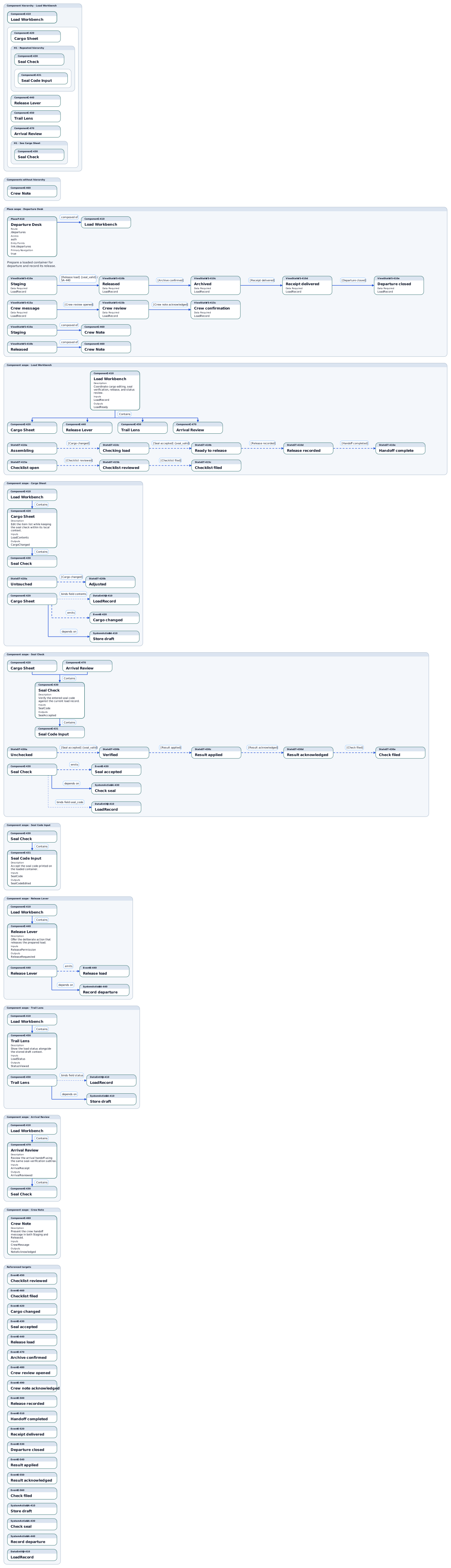
departure_desk.sdd UI Contracts DiagramDetail: DetailedDecorators: Type, ID
Departure Desk sheet with --details detailed, including State sequences, outgoing contracts and referenced targets
Compare the local parents of Seal Check with its two overview occurrences, then follow its own bindings and emissions to their local target references.

Detail and decorators
As with the other diagram types, --detail selects content. --decorators selects the type/ID header shown on nodes. Detailed content does not automatically enable those headers.
| Content | compact | detailed |
|---|---|---|
| Component hierarchy relationships | Preserved in overview and retained scopes | Preserved in overview and retained scopes |
| Redundant Component scopes | Omitted after detail selection | Omitted after detail selection |
| ViewState sequences and explicit composition | Shown | Shown |
| Component description, inputs, outputs | Omitted | Shown when authored on the focal Component |
| Place primary navigation | Shown when authored | Shown when authored |
| Place route/key, access, entry points, description | Omitted | Shown when authored |
| ViewState data required | Omitted | Shown when authored in sequence cards |
| State sequences and supporting contracts when any ViewState is present | Omitted | Shown |
| State sequences and supporting contracts when States exist and no ViewState is present | Shown through fallback (see below) | Shown |
| Empty Place scopes | Omitted, with an omission note | Retained |
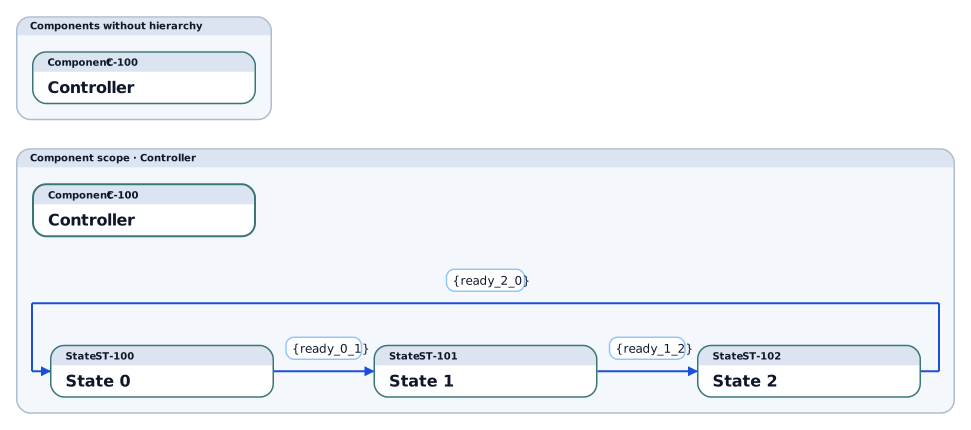
The fallback test is projection-wide. A Component with States but no local ViewStates does not receive its own compact fallback if a ViewState exists elsewhere in the projection. Compact is therefore a selected-content view, not evidence that omitted contracts are absent from the source. An empty Place is assessed against the content visible for the selected detail.
Fallback Example Decorators: Type, ID
Fallback without primary ViewStates: 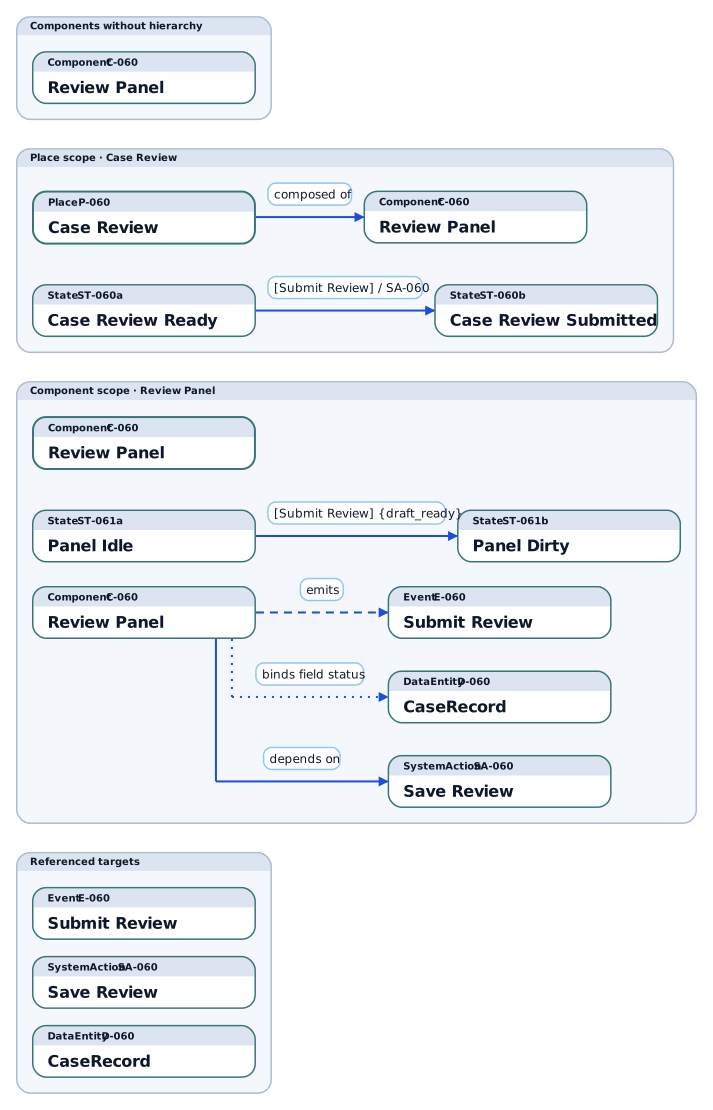
Decorator choices are none, type, id, and type,id. Container titles and H locators remain visible in every case. ID decorators display the original semantic ID, never the internal visual-occurrence ID. When decorators are omitted, the independent user preference and bundle fallback resolve the setting.
Detail Level & Decorators
--detail compact --decorators type, id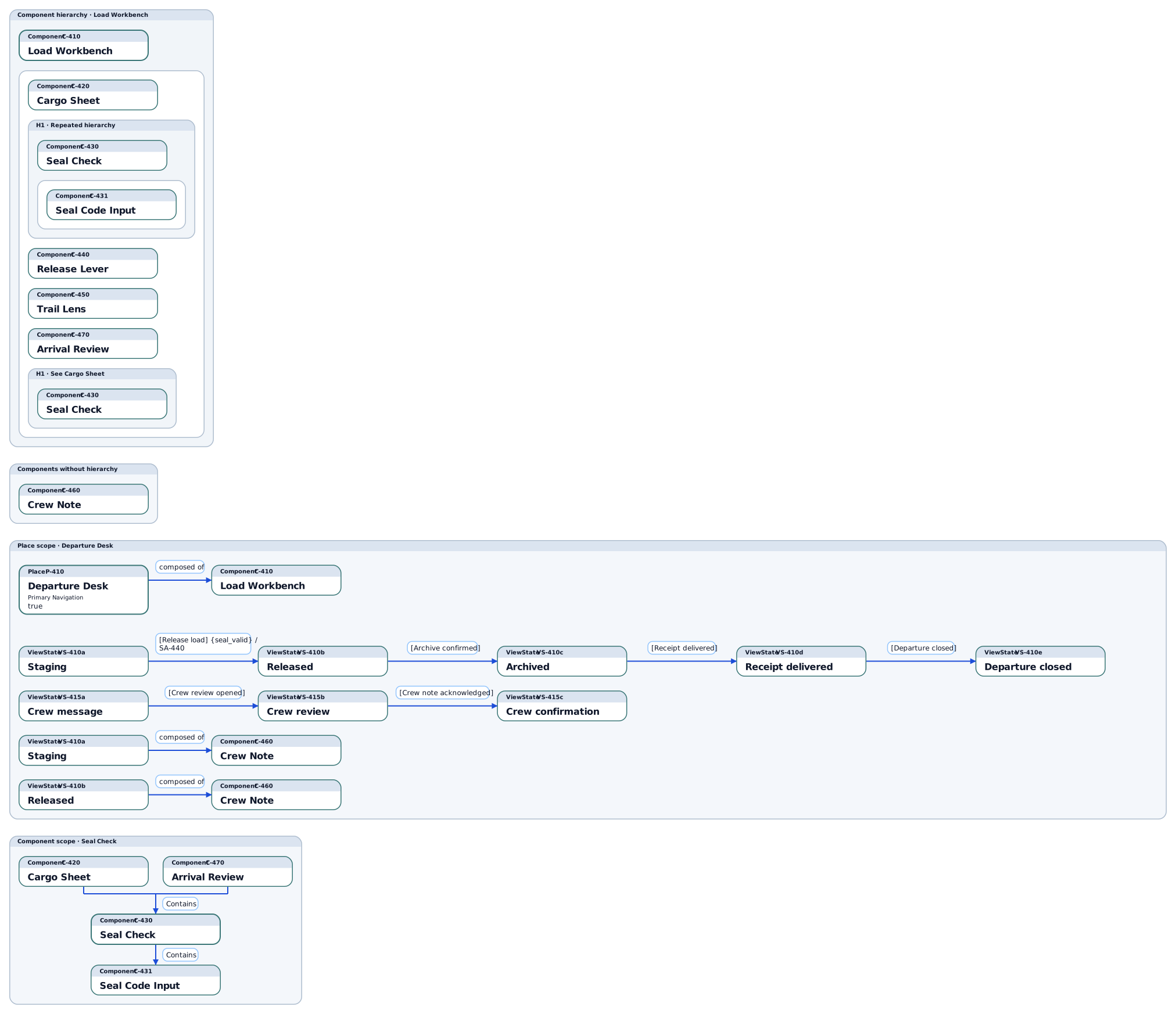
CSS Styling
Diagrams are themed with CSS. For example, node appearance (across diagram types) is defined in theme.ts and appearance of containers in UI Contracts diagrams is in
uiContractsContainer.ts
Visual sizing and container treatment
Semantic cards use shared-node measurement, a standard width, and content-driven height. Context and target references stay lean; selected richer attributes belong to focal or sequence occurrences. Repetition therefore need not repeat every attribute.
Local groups use their intrinsic measured widths. Shared measurement can retain excess space on the right of some sequence groups; the implementation does not crop or shrink those positioned frames afterward. Longer sequences grow the diagram horizontally rather than shrinking its cards and text.
Implementation map for maintainers
The staged path is:
Projection + compiled graph + loaded view policy
  → UI Contracts presentation model
  → RendererScene
  → MeasuredScene
  → PositionedScene
  → SVG
  → PNG rasterization
The compiled graph supplies authored ordering, properties, and transition annotations; the presentation model matches these against projected identities and relationship multiplicity. Rendering does not mutate the projection.
| Responsibility | Source |
|---|---|
| Machine-owned roles, labels, relationship styles, content and visibility | bundle/v0.1/core/views.yaml |
Bundle presentation validation and resolution, reached through loadBundle(...) | src/bundle/uiContractsPresentation.ts |
| Identity/occurrence separation, reuse, ownership, fallback, local groups, omissions and provenance | src/renderer/uiContractsPresentationModel.ts |
| Public scene builder and SVG/PNG entrypoints | src/renderer/staged/uiContracts.ts |
| Sheet assembly, enclosures, neighborhoods, composition, ports and coverage checks | uiContractsPresentationScene.ts |
| Single-source outgoing groups | uiContractsFanout.ts |
| Transition-region inputs and return-channel reservations | uiContractsTransitions.ts |
| Native title measurement and enclosure painting | uiContractsContainer.ts |
| Ordinary SVG arrow paths for import compatibility | uiContractsArrowheads.ts |
| Shared staged execution and artifact output | pipeline.ts, svgBackend.ts |
| Backend-aware preparation and public preview integration | prepareProjectionForRender.ts, previewWorkflow.ts |
Scene occurrence IDs identify a card's role and context separately from its semantic ID. Routed connector segments retain mappings to authored relationship IDs. Ownership is accounted for structurally; the final builder checks other visible relationships for scene representation and checks visible identities for occurrences. Containment cycles produce an explicit renderer error instead of recursive expansion.
Policy changes belong in the bundle and must affect runtime through the loaded policy. Do not add hidden lists of node types, relationship names, or detail rules to the scene builder. Preserve the staged boundary: shared placement, routing, repair, and validation were unchanged by this implementation. The view provides their inputs rather than final coordinates or routes.
Relevant tests include presentation-model policy and identity tests, scope tests, complete-sheet tests, topology tests, container tests, and public staged renderer tests. Acceptance must precede snapshot refresh; a snapshot is evidence of output, not the presentation contract.